
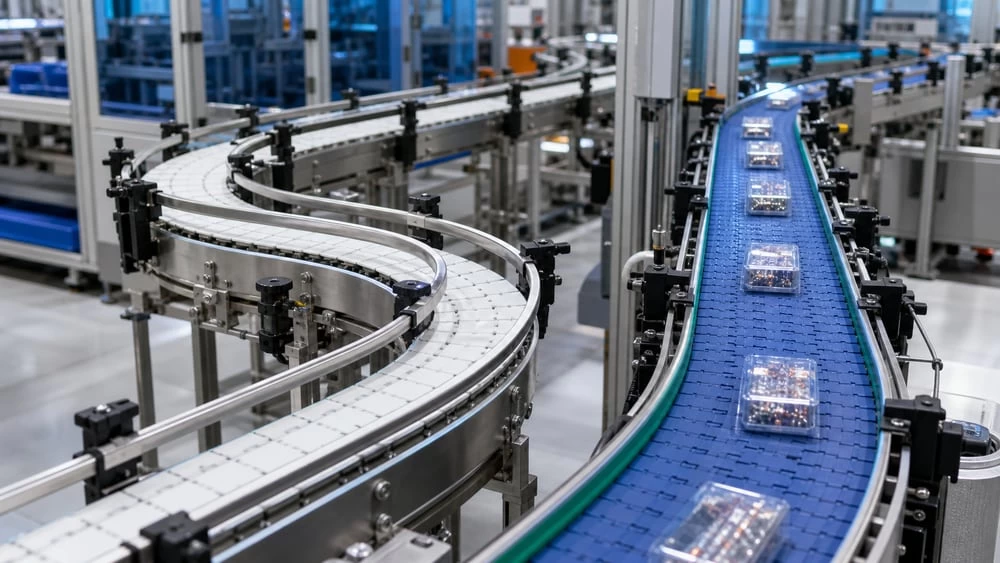
Buyer Brief
Flexible-chain conveyors are often selected for compact multi-curve routing and supported products, while wider modular-chain conveyors can provide a broader carrying surface. Product geometry, load, speed, guide-rail needs, transfer points, cleaning, and route complexity should drive the decision.
In This Guide
Evaluate how the product is supported
A narrow flexible chain usually supports the product along a central or defined contact line and uses guide rails for stability. A modular chain can create a wider surface and may support products that need more base contact.
Neither option compensates for an unstable package. Share the product’s base, center of gravity, stiffness, orientation, and acceptable contact zones.
Routing is more than a curve radius
Flexible-chain systems can route through horizontal and vertical curves in compact layouts, subject to the selected chain and product. Modular chains can also curve, incline, and transfer, but width and edge geometry affect the layout.
Check guide rails, accumulation, side pressure, incline retention, product rotation, and the transition between conveyor sections. A route that works for an empty chain may not work for the actual product.
Plan cleaning and maintenance around the environment
Dust, oil, liquids, abrasive particles, and cleaning chemicals influence chain material, wear strips, frame design, and access. Define whether cleaning is dry, wiped, rinsed, or washdown.
Maintenance planning should include chain tension, wear-strip inspection, sprockets, return path, lubrication policy, guide rails, and spare sections. Confirm replacement procedures before the line is installed.
Selection comparison
| Factor | Flexible chain | Modular chain |
|---|---|---|
| Carrying surface | Narrower defined contact path | Wider linked surface options |
| Routing | Compact multi-curve layouts | Straight, curve, incline, and wide-bed layouts |
| Product guidance | Often relies on side guides | Depends on width and product stability |
| Transfers | End geometry and guide transition matter | Nose-bar, sprocket, and edge geometry matter |
| Maintenance | Chain, guides, wear strips, return path | Modules, pins, sprockets, wear strips |
Recommended Project Workflow
Send product samples
Include the smallest, tallest, softest, and least stable products.
Mark the required route
Show curves, elevation changes, transfers, work areas, and cleaning access.
Define product behavior
State orientation, spacing, accumulation, and whether products may touch.
Approve a run test
Test transitions, curves, accumulation, guide pressure, and restart.
Frequently Asked Questions
Which conveyor is better for tight curves?
Flexible chain is often considered for compact routing, but the product, load, guide rails, and approved radius still control the decision.
Can modular chain carry small parts?
Possibly, if the module opening, transfer gap, edge, and product base are compatible. Test the smallest part.
Can products accumulate on chain conveyors?
Accumulation depends on product friction, guides, back pressure, surface, and controls. Define the permitted behavior.
What causes guide-rail problems?
Excessive side pressure, poor alignment, unstable products, tight curves, heat, and incompatible materials can contribute.
What should be included in spare parts?
Confirm chain or modules, pins, sprockets, wear strips, guide components, and any special tools required for replacement.
Planning a Conveyor Project?
Send the product, load, throughput, layout, environment, controls, and destination requirements for an engineering review.