
Buyer Brief
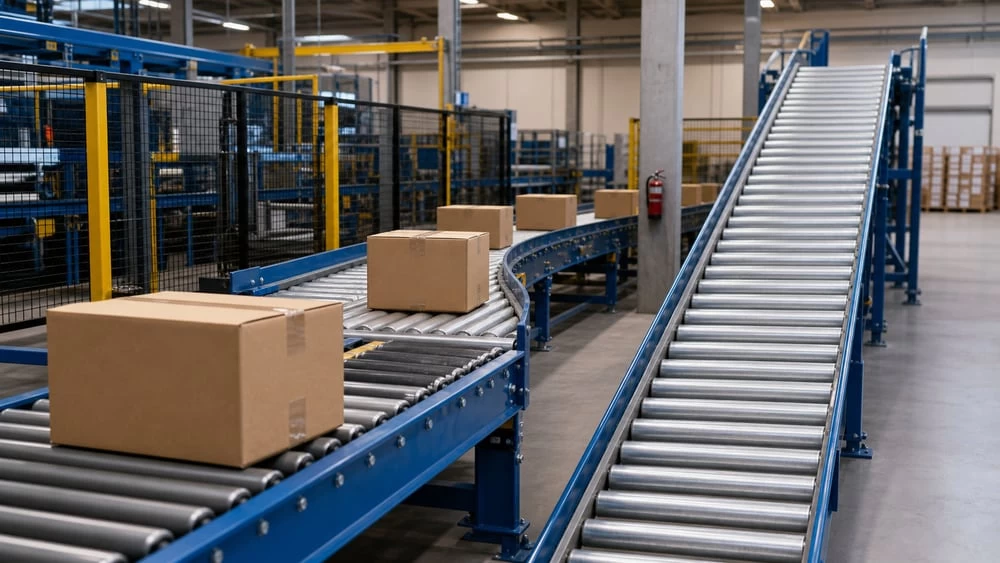
Gravity rollers use slope or manual force to move suitable loads, while powered rollers use a drive to control movement. The choice depends on the load base, weight range, route, elevation, accumulation, release logic, operator interaction, and required throughput.
In This Guide
Check whether the product is roller-compatible
The load should have a sufficiently rigid, flat, and stable bottom. Roller diameter, pitch, width, and support count must suit the smallest and largest load.
Soft bags, irregular feet, open-bottom containers, damaged pallets, or very small items may bridge poorly or become unstable. Test representative loads before approving the conveyor.
Use gravity only when the route supports it
A gravity conveyor requires a controlled slope, push force, or other source of motion. The resulting speed changes with weight, friction, roller condition, and slope, so braking and end stops may be needed.
Operator ergonomics should be reviewed when loads are pushed manually. A layout that appears simple can create excessive force or runaway risk if the product range is not considered.
Use power when flow must be controlled
A powered roller conveyor can support controlled speed, metering, zone release, merges, and coordination with machines. The drive and control architecture should match the load, accumulation method, start frequency, and fault response.
Power also introduces nip points, stored energy, controls, and maintenance requirements. Guarding, emergency stops, isolation, and safe access belong in the design.
Roller conveyor decision table
| Factor | Powered roller | Gravity roller |
|---|---|---|
| Motion source | Motorized drive or driven zones | Slope or manual force |
| Flow control | Speed and release can be controlled | Depends on slope, friction, and braking |
| Accumulation | Can use controlled zones | Requires suitable stops and spacing |
| Utilities | Electrical and controls scope | Usually no line drive |
| Suitable use | Automated or controlled flow | Simple compatible routes and loads |
Recommended Project Workflow
Test the load base
Confirm stability across the proposed roller diameter and pitch.
Define the route
Include slope, curves, transfers, workstations, and discharge control.
Choose accumulation behavior
State whether loads may touch, must remain separated, or require zero-pressure zones.
Review operator interaction
Measure push, pull, reach, access, and jam-clearing needs.
Frequently Asked Questions
How many rollers should support a load?
Use enough support points for the actual base geometry and stiffness. The supplier should confirm roller pitch against the smallest load.
Can gravity conveyors handle pallets?
Some pallets are compatible, but bottom-board orientation, condition, weight, slope, braking, and transfer geometry must be reviewed.
What is zero-pressure accumulation?
It is a controlled method that keeps queued loads from pressing into one another. The zone and release logic should match the product.
Can powered and gravity sections be combined?
Yes. Confirm transition height, speed, braking, load stability, and controls at the interface.
What sample should be tested?
Use the lightest, heaviest, smallest, largest, least rigid, and most unstable representative loads.
Planning a Conveyor Project?
Send the product, load, throughput, layout, environment, controls, and destination requirements for an engineering review.