Buyer Brief
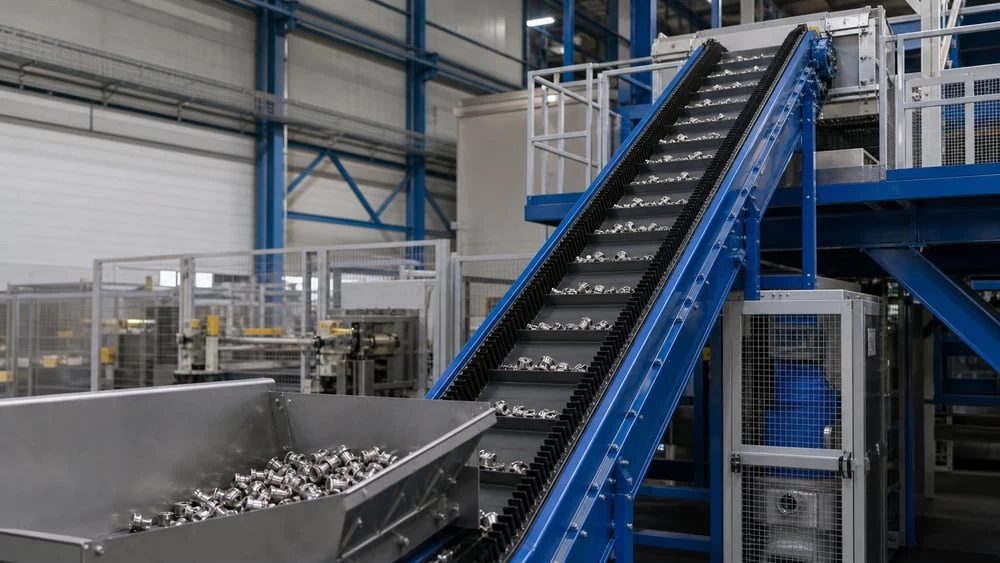
Use an incline belt conveyor with sidewalls when loose, small, or unstable items must be contained while moving between elevations. The design should be based on product flow behavior, incline angle, vertical lift, feed consistency, cleat and sidewall geometry, discharge, belt return, cleaning, and safety access.
In This Guide
Containment starts at the loading point
Sidewalls help contain product at the belt edges, while cleats divide the carrying surface and reduce rollback. Their height and spacing should fit the product size, feed rate, and incline rather than follow a generic pattern.
A poorly controlled feed can overfill pockets, spill at the edges, or create uneven loading. Define the upstream equipment, drop height, impact, surge volume, and method used to meter product onto the belt.
Incline angle changes product behavior
As angle increases, rollback, sliding, and pocket fill become more critical. Smooth, round, oily, fragile, or irregular items behave differently even at the same mass flow.
Request a test with representative product when behavior is uncertain. The test should examine loading, carryback, sidewall flexing, cleat filling, discharge, and restart after a stop.
Design for discharge, return, and cleaning
The product must leave the belt cleanly without being trapped by a cleat or sidewall. Discharge trajectory, receiving equipment, guard clearance, and access for jam removal should be reviewed together.
The return path needs room for the selected sidewalls and cleats. Cleaning method, debris collection, belt tracking, take-up access, and replacement procedure should be planned before installation.
Inputs that define an incline conveyor
| Input | Design effect | Evidence to provide |
|---|---|---|
| Product | Belt, cleat, sidewall, and discharge behavior | Sample, photos, dimensions, bulk behavior |
| Capacity | Pocket fill, belt speed, and feed control | Average and surge rate |
| Geometry | Incline angle, vertical lift, and footprint | Plan and elevation drawing |
| Environment | Materials and cleaning access | Dust, liquid, temperature, cleaners |
| Interface | Loading and discharge transitions | Upstream/downstream equipment data |
Recommended Project Workflow
Characterize the product
Record size range, shape, surface, fragility, temperature, and tendency to roll or stick.
Define the feed
State average flow, surge, drop height, and metering method.
Confirm the geometry
Provide lift, available length, angle constraints, and discharge elevation.
Run representative tests
Observe containment, rollback, carryback, tracking, and discharge.
Frequently Asked Questions
Do sidewalls eliminate all spillage?
No. Loading control, belt tracking, product behavior, fill level, and transfer design still matter.
How are cleat spacing and height selected?
They depend on product size, incline, capacity, belt speed, discharge, and cleaning needs.
Can the conveyor start while loaded?
That operating case must be included in drive and belt review if it is required.
What if the product is fragile?
Control drop height, impact, pocket fill, belt speed, and discharge. Use representative-product testing.
What maintenance access is needed?
Provide access to loading, discharge, tracking, take-up, drive, guards, return path, and cleaning points.
Planning a Conveyor Project?
Send the product, load, throughput, layout, environment, controls, and destination requirements for an engineering review.