Buyer Brief
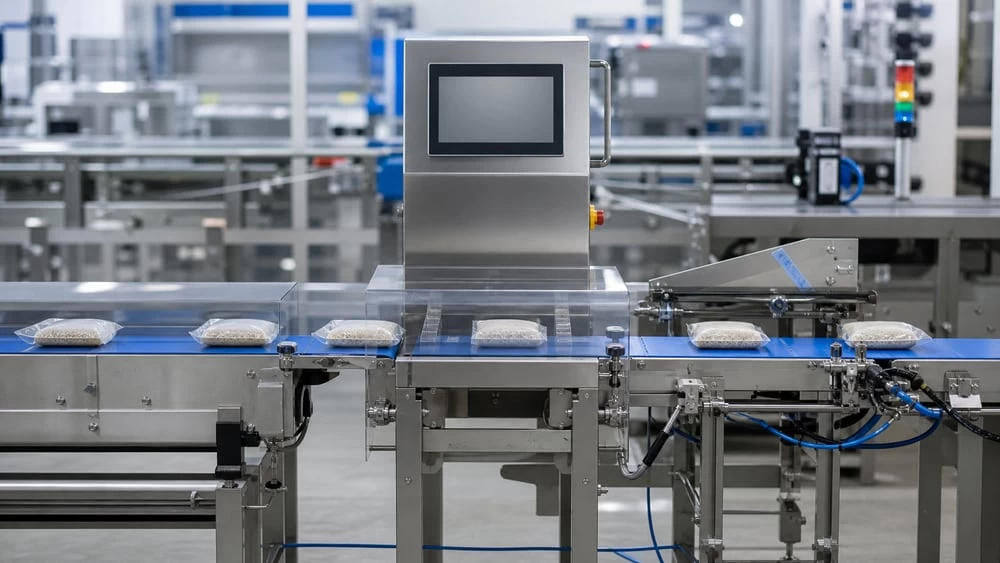
A dynamic checkweigher needs stable product presentation, controlled spacing, suitable infeed and outfeed transitions, a defined reject sequence, and an approved test method. Accuracy cannot be separated from vibration, airflow, belt condition, product movement, speed, and the surrounding line.
In This Guide
Present one stable product at a time
The product should enter the weighing belt with enough separation to complete the measurement. Touching products, unstable bags, liquid movement, bouncing, or changing orientation can affect the result.
Define every product size, mass range, package base, line speed, and spacing. Upstream metering may be required when the production machine does not provide consistent gaps.
Protect the weighing section from outside influence
Nearby drives, floor vibration, contact from guide rails, belt tension, air movement, and product transfers can introduce disturbance. The checkweigher and adjacent conveyors should be laid out to minimize these effects.
Transitions must also support small or flexible products without trapping, tipping, or dragging them. Representative samples should be used during design and testing.
Define reject, records, and line response
Set the acceptable weight limits and determine how underweight, overweight, and unweighed products are handled. The reject device, collection area, confirmation sensor, bin monitoring, and alarm logic should be documented.
Clarify which data must be exchanged with the line controller and which records belong to the quality system. The buyer should approve test weights, product tests, frequency, and acceptance criteria.
Integration checklist
| Area | Buyer provides | Supplier confirms |
|---|---|---|
| Product | Size, weight range, base, behavior | Compatible belt and transition |
| Flow | Speed, rate, minimum spacing | Infeed and weighing sequence |
| Environment | Vibration, drafts, cleaning | Isolation and material choices |
| Reject | Disposition and quality procedure | Device, confirmation, alarm logic |
| Testing | Weights, products, pass criteria | Factory and site test method |
Recommended Project Workflow
List every SKU condition
Include package variation, target weight, tolerances, and orientation.
Measure product spacing
Record minimum and typical gaps at production speed.
Review the physical layout
Check floor, vibration sources, transitions, reject space, and service access.
Approve test evidence
Define static checks, dynamic product runs, reject challenges, and records.
Frequently Asked Questions
Why can a checkweigher perform differently after installation?
Floor vibration, line interfaces, airflow, belt setup, speed, product spacing, and site conditions can differ from the factory.
Can touching products be weighed separately?
Reliable dynamic weighing normally requires defined separation. Review upstream metering when products arrive without a stable gap.
What happens to an unweighed product?
The control response should be defined in the quality procedure and may include rejection, alarm, or line stop.
Does the conveyor need special cleaning access?
Access depends on product and sanitation needs, but belts, transitions, catch areas, and reject devices should be reachable.
What samples are needed?
Provide minimum, maximum, least stable, and worst-case products in representative packaging.
Planning a Conveyor Project?
Send the product, load, throughput, layout, environment, controls, and destination requirements for an engineering review.