Buyer Brief
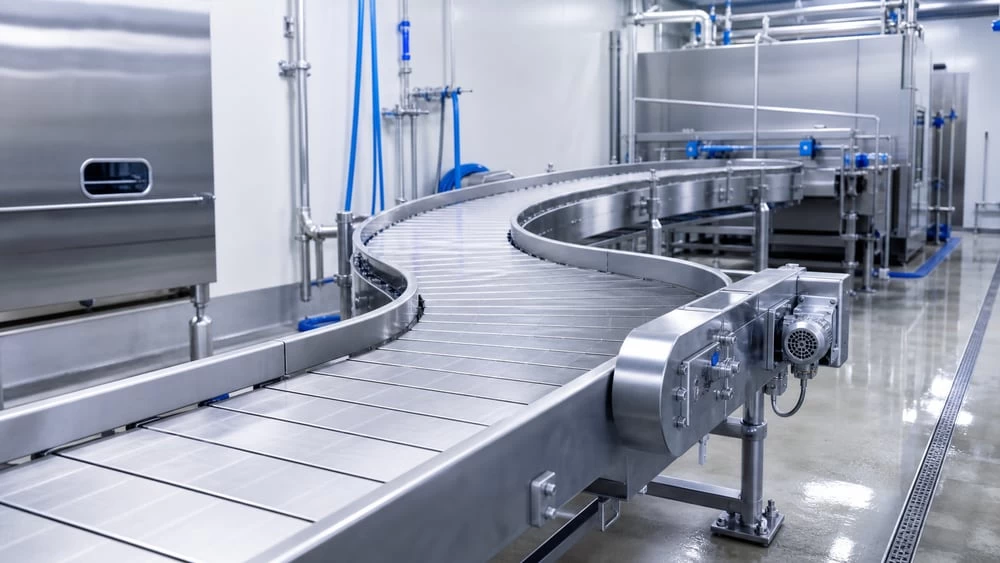
Stainless steel slat chain provides a durable, continuous carrying surface for suitable containers and industrial products. Material choice alone does not make a conveyor hygienic: frame geometry, joints, drainage, access, wear strips, transfers, cleaning chemicals, and the site’s sanitation procedure all matter.
In This Guide
Confirm that the product fits a slat surface
Slat width, flatness, hinge geometry, curve behavior, guide rails, and transfer gaps must suit the product base. Tall, narrow, soft, or irregular products may need additional guidance or a different carrying surface.
Share the smallest and largest product, center of gravity, base material, temperature, and permitted contact. Curves and accumulation should be tested with the least stable product.
Define what “cleanable” means at the site
A dry wipe, low-pressure rinse, foaming wash, and chemical sanitation place different demands on materials, drainage, seals, bearings, electrical enclosures, and access. Provide the cleaning method and chemical information during design.
Review horizontal ledges, hollow sections, fasteners, joints, drip paths, and places where residue may collect. The buyer’s sanitation and risk team should approve the final design for the intended process.
Plan wear and maintenance in the wet or corrosive environment
Stainless slats still interact with sprockets, pins, wear strips, guides, shafts, bearings, and lubricants. Chemical compatibility, abrasion, temperature, and wash frequency can affect service life.
Maintenance instructions should define inspection points, chain tension, permitted lubricants, replacement sections, and safe access. Select materials from the complete environment rather than the word “stainless.”
Cleanability questions for the supplier
| Area | Question | Reason |
|---|---|---|
| Cleaning | How is the conveyor cleaned and at what pressure? | Drives access, seals, drainage, and materials |
| Chemicals | Which agents and concentrations are used? | Checks compatibility |
| Product | Is product exposed or packaged? | Changes hygiene and containment needs |
| Drainage | Where can liquid and residue collect? | Supports sanitation review |
| Maintenance | Which parts require tools or removal? | Controls cleaning and service time |
Recommended Project Workflow
Document the environment
List liquids, chemicals, temperature, abrasion, and cleaning frequency.
Review the product interface
Confirm slat width, stability, guides, curves, and transfers.
Inspect the cleanability drawing
Check access, joints, ledges, drainage, return path, and guards.
Approve a cleaning trial
Use the site method and inspect areas that are difficult to reach.
Frequently Asked Questions
Does stainless steel mean the conveyor can be washed down?
Not by itself. Bearings, drives, wiring, enclosures, seals, drainage, and the entire construction must suit the cleaning method.
Can stainless slat chain run curves?
Some slat-chain systems can curve, but slat geometry, radius, guides, product stability, and speed must be confirmed.
How should cleaning chemicals be specified?
Provide product name, concentration, temperature, contact time, frequency, and rinse conditions for compatibility review.
What causes product instability on slats?
Transfers, curves, guide pressure, center of gravity, speed changes, gaps, and an unsuitable base can contribute.
Who approves hygienic suitability?
The buyer’s process, sanitation, quality, and risk teams should approve the design for the actual application.
Planning a Conveyor Project?
Send the product, load, throughput, layout, environment, controls, and destination requirements for an engineering review.