
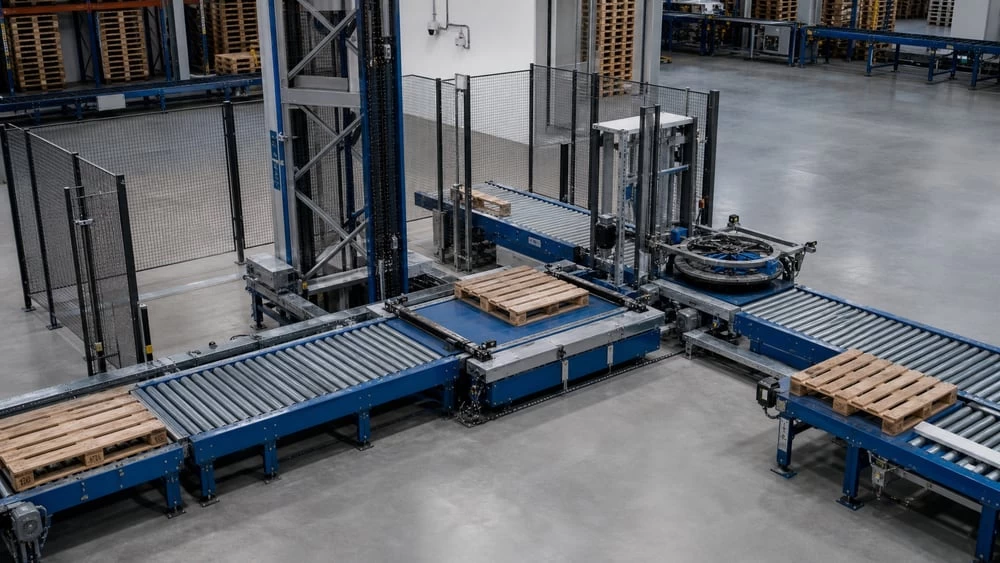
Buyer Brief
Choose a motion module by the movement the process needs: vertical elevation, transverse routing, orientation change, or a combination. Payload is only the starting point; stroke, cycle, center of gravity, interface heights, positioning, guarding, utilities, and recovery behavior also belong in the selection.
In This Guide
Define the movement and end positions
A lift changes elevation, a transverse unit moves a pallet between parallel paths, and a rotation unit changes orientation. Combined modules may save space, but their sequence and simultaneous motions require careful review.
Provide plan and elevation drawings with exact pickup and discharge positions. Include pallet overhang, fixture envelope, sensor locations, and any operator or robot access.
Use the complete moving mass
Calculate the pallet, fixture, workpiece, and any moving platform or tooling included in the module. An uneven or high center of gravity can affect acceleration, stability, bearing loads, and stopping.
The maximum moving mass should be checked with the required stroke and cycle. A nominal load class does not automatically approve every speed, orientation, or duty cycle.
Specify interfaces and fault recovery
Mechanical interfaces include conveyor height, transfer direction, support geometry, clearances, and guarding. Electrical interfaces include sensors, valves, drives, interlocks, safe states, and communication with adjacent equipment.
Define what happens after a blocked transfer, lost pallet signal, low air pressure, power interruption, or emergency stop. A recoverable sequence reduces manual intervention and protects the workpiece.
Which motion module solves which problem?
| Module | Primary movement | Critical questions |
|---|---|---|
| Lift unit | Vertical | Stroke, load, level accuracy, hold condition |
| Transverse unit | Side-to-side | Lane spacing, transfer gap, support points |
| Rotation unit | Angular orientation | Angle, envelope, center of gravity, cables |
| Lift and transfer | Vertical plus transverse | Motion sequence, combined cycle, clearance |
| Lift and rotate | Vertical plus angular | Fixture stability and end-position confirmation |
Recommended Project Workflow
Draw all positions
Show start, end, travel envelope, interfaces, and surrounding equipment.
Define the motion profile
State payload, stroke, speed, acceleration, dwell, and cycles per hour.
Confirm utilities
Provide voltage, frequency, control standard, and available pneumatic conditions.
Witness recovery tests
Test blocked movement, sensor faults, power interruption, and safe restart.
Frequently Asked Questions
Can a higher load-rated module always run the required cycle?
Not automatically. Stroke, acceleration, duty cycle, drive, and heat must also be reviewed.
How is pallet position confirmed?
Common designs use presence and end-position sensors, but the exact arrangement should follow the required sequence and tolerance.
Can lift and transfer motions occur at the same time?
Only if the specific design and risk assessment support it. Many systems use an interlocked sequence.
What should happen during power loss?
Define the safe state, load-holding behavior, energy isolation, and restart sequence during design review.
Which drawings are most useful?
Send a scaled plan, elevation, pallet and fixture drawings, adjacent equipment interfaces, and the required motion sequence.
Planning a Conveyor Project?
Send the product, load, throughput, layout, environment, controls, and destination requirements for an engineering review.