
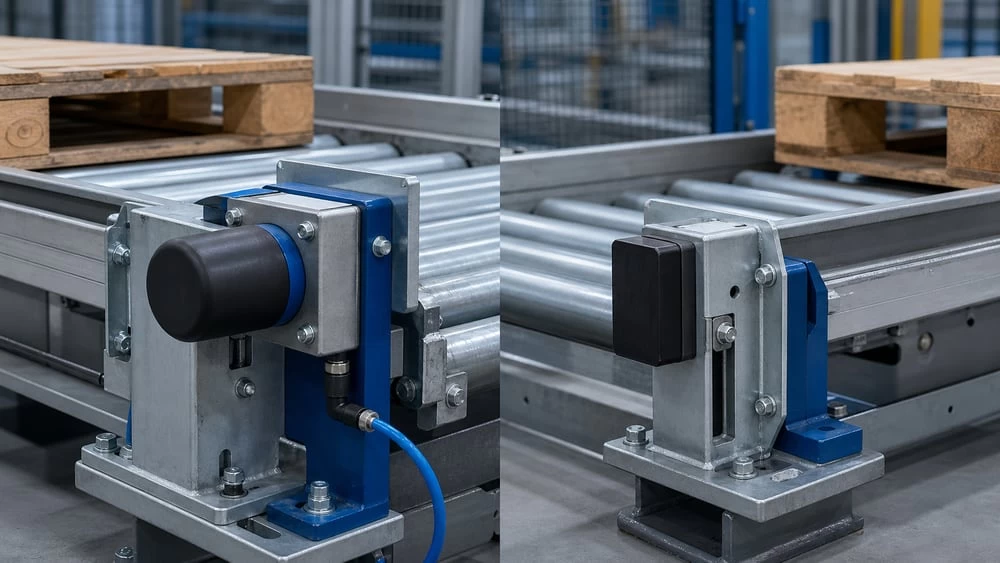
Buyer Brief
A stopper is part of the motion-control sequence, not a universal accessory. A buffered design can reduce the abruptness of pallet deceleration, while a non-buffered design may be suitable for lighter or slower applications where the stopping energy remains within the approved range.
In This Guide
Estimate the energy arriving at the stop
The stopper must handle the moving pallet, fixture, and workpiece at the actual approach speed. Higher mass and speed increase the stopping demand, and an off-center load can introduce additional forces.
Do not select from payload alone. Pallet contact height, impact point, queue condition, stop frequency, pneumatic supply, and required life all influence the result.
When buffering can help
A buffered stopper introduces controlled deceleration before the pallet reaches its final held position. It can reduce shock transmitted to the product, fixture, pallet, conveyor structure, and stop mechanism.
Buffer travel and recovery time must fit the process. The design also needs a clear rule for detecting the pallet, confirming the stop position, and releasing it without interference.
When a non-buffered design may be considered
A compact non-buffered stopper can suit loads and speeds that do not require a damping stroke. It may simplify the mechanism, but it should still be checked against impact, contact geometry, mounting stiffness, and stop frequency.
If the application changes later, increasing speed or payload without rechecking the stopper can create damage or unreliable positioning. Treat operating limits as project-specific.
Selection comparison
| Factor | Buffered stopper | Non-buffered stopper |
|---|---|---|
| Deceleration | Controlled over a damping stroke | More immediate stop |
| Typical reason to use | Reduce impact on load and mechanism | Compact stop for suitable load and speed |
| Cycle consideration | Buffer and reset time | Actuation and release time |
| Key input | Mass, speed, stroke, contact point | Mass, speed, contact point |
| Maintenance | Inspect damping and actuation | Inspect contact and actuation |
Recommended Project Workflow
Define approach conditions
State maximum payload, speed, spacing, and queue behavior.
Confirm contact geometry
Show the pallet stop face, height, direction, and permitted contact zone.
Select detection logic
Specify pallet-present, stop-up, stop-down, and release confirmation signals.
Test repeated cycles
Verify stopping, product stability, release, and fault recovery with representative loads.
Frequently Asked Questions
Does a buffered stopper improve positioning accuracy?
It can reduce impact, but final positioning depends on the complete locating and stop arrangement. Specify the required tolerance separately.
Can one stopper cover a wide payload range?
Possibly, but the minimum and maximum loads, speeds, and contact conditions must be reviewed as a design envelope.
What happens when pallets queue?
The first stopper in the queue and the conveyor must be designed for the agreed accumulation behavior and combined forces.
Are sensors required on the stopper?
Many automated lines monitor pallet presence and stopper position. The exact I/O depends on the sequence and risk assessment.
Which project data is essential?
Provide pallet drawing, load, center of gravity, speed, stop frequency, queue condition, pneumatic supply, and position tolerance.
Planning a Conveyor Project?
Send the product, load, throughput, layout, environment, controls, and destination requirements for an engineering review.