Buyer Brief
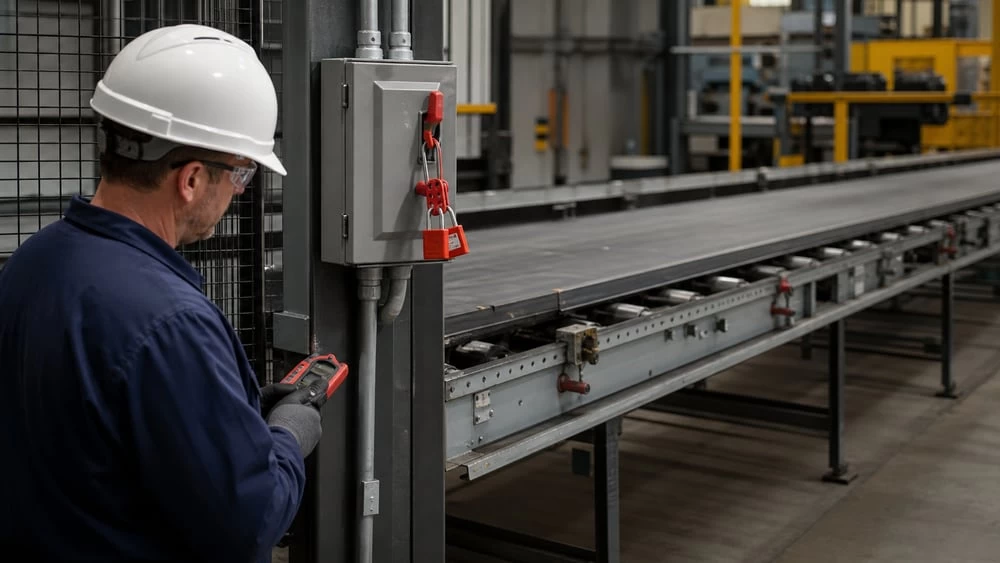
Conveyor maintenance can involve electrical, pneumatic, hydraulic, gravity, spring, mechanical, and process energy. OSHA 29 CFR 1910.147 establishes minimum performance requirements for controlling hazardous energy during servicing and maintenance where unexpected energization, startup, or release of stored energy could cause injury.
In This Guide
Identify every energy source and isolation point
Do not stop at the main electrical disconnect. Conveyor lifts, tensioners, accumulators, pneumatic stoppers, suspended loads, springs, flywheels, and connected equipment may retain or receive energy.
The equipment documentation should show isolation devices, boundaries, lockability, stored-energy controls, and verification points. Coordinate interfaces when several machines share power, air, controls, or product flow.
Design new equipment to support the site procedure
OSHA states that when new machines are installed or major repair, renovation, or modification occurs, energy-isolating devices must be designed to accept a lockout device when required by the standard. Controls such as push buttons or PLC commands are not automatically energy-isolating devices.
Place disconnects and valves where they can be identified and safely operated. Provide means to block or restrain gravity and stored mechanical energy where the maintenance task requires it.
Plan verification, group work, and restart
Authorized employees need a method to verify isolation and de-energization before work. The procedure should address reaccumulation of energy, shift changes, contractors, group lockout, temporary testing, and restoration to service.
The employer owns the site energy-control program, training, inspections, and task-specific procedures. Equipment suppliers can support the program with accurate energy maps, lockable devices, and maintenance instructions.
Conveyor energy-source review
| Energy | Possible source | Planning question |
|---|---|---|
| Electrical | Motors, panels, remote feeds | Which disconnect establishes isolation? |
| Pneumatic | Stoppers, lifts, actuators | How is pressure isolated and relieved? |
| Gravity | Raised modules or suspended loads | How is movement blocked or lowered? |
| Mechanical | Springs, tensioners, rotating parts | How is stored motion restrained? |
| Connected equipment | Upstream or downstream machines | Where is the isolation boundary? |
Recommended Project Workflow
Create an energy map
Identify sources, isolation devices, stored energy, and connected equipment.
Define the task boundary
State what maintenance is performed and which motion could create exposure.
Provide lockable isolation
Confirm devices, access, identification, and restraint methods.
Validate the procedure
Verify shutdown, isolation, stored-energy control, zero-energy check, and restart.
Frequently Asked Questions
Is pressing the conveyor stop button enough for maintenance?
A control button does not necessarily isolate hazardous energy. Follow the employer’s energy-control procedure and applicable requirements.
Do pneumatic devices need attention after electrical isolation?
Yes. Air pressure and gravity can remain even when electrical power is off. The procedure should address all energy sources.
What about testing that requires power?
OSHA provides specific requirements and exceptions for some situations. The employer should develop a compliant task procedure.
Who prepares the lockout procedure?
The employer is responsible for its energy-control program. Suppliers should provide accurate equipment and energy information.
Should connected machines be included?
Yes, when they can introduce energy or motion into the maintenance boundary. Define the complete isolation scope.
Authoritative References
These references support the regulatory or standards context. Project requirements must still be confirmed for the installed application.
Planning a Conveyor Project?
Send the product, load, throughput, layout, environment, controls, and destination requirements for an engineering review.