Buyer Brief
Conveyor safety should be based on a documented risk assessment covering normal operation, loading, unloading, cleaning, adjustment, jams, maintenance, and foreseeable misuse. OSHA requires guarding against hazards such as ingoing nip points and rotating parts; the final system must also follow applicable site, state, electrical, and industry requirements.
In This Guide
Identify hazard locations before finalizing the layout
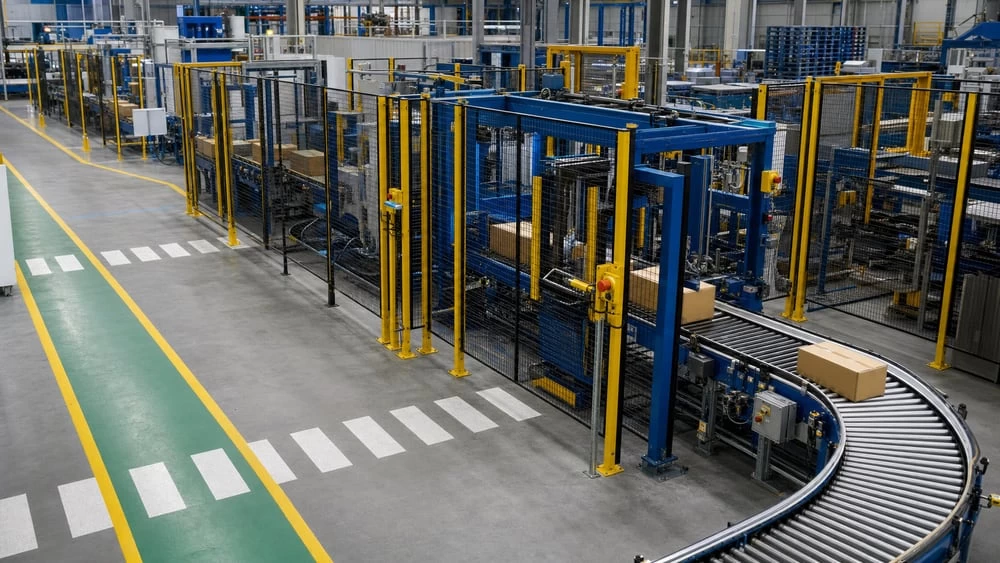
Review drive and tail ends, belt and chain entry points, rollers, transfers, curves, lifts, rotation units, stoppers, pinch points, falling material, and areas where people cross or work near the line. Access needs should be designed with guarding rather than discovered during installation.
OSHA 29 CFR 1910.212 requires one or more guarding methods to protect operators and other employees from hazards including point-of-operation hazards, ingoing nip points, and rotating parts. Project-specific interpretation belongs to the responsible safety authority.
Emergency stopping needs a complete reset and restart strategy
Locate stop controls where exposed personnel can reach them, considering long accessible conveyor runs and workstations. Define which equipment stops, what energy remains, how the stop is indicated, and where reset is permitted.
Resetting a stop device should not itself create an unexpected restart. The control sequence should require a deliberate restart after the area has been checked according to the site procedure.
Design safe access for operation and maintenance
Provide adequate walkways, crossovers, clearances, lighting, and guarded access to inspection and service points. Avoid layouts that encourage workers to climb over or reach through conveyors.
Jams, cleaning, belt tracking, sensor adjustment, and component replacement should be addressed in the risk assessment and energy-control procedure. The safest service task is one planned before the equipment is built.
Safety review by operating mode
| Mode | Typical exposure | Design review |
|---|---|---|
| Automatic run | Moving products and drive parts | Guards, zones, warnings, stops |
| Loading/unloading | Hands near transfer points | Distance, guides, controls, ergonomics |
| Jam clearing | Stored energy and unexpected motion | Isolation and safe access |
| Cleaning | Removed guards or wet conditions | Energy control, drainage, access |
| Maintenance | Multiple energy sources | Lockout points and verification |
Recommended Project Workflow
Perform a risk assessment
Include every life-cycle phase and reasonably foreseeable task.
Map people and hazards
Show workstations, aisles, crossings, service points, and moving zones.
Define safeguarding
Select guards, interlocks, stops, distances, and procedures for each hazard.
Validate the installed line
Check access, stopping, reset, restart, signage, training, and documentation.
Frequently Asked Questions
Does an emergency stop replace machine guarding?
No. Emergency stopping is not a substitute for preventing access to hazardous moving parts.
Where should pull cords or stop buttons be located?
Use the risk assessment and applicable requirements to place accessible devices along exposed areas and workstations.
Can a conveyor restart when an E-stop is reset?
Reset should not cause automatic unexpected restart; the restart sequence should be deliberate and controlled.
Who approves the guarding design?
The responsible employer, integrator, safety authority, and other project stakeholders should approve compliance for the installed application.
Are OSHA construction conveyor rules always applicable in a factory?
Different OSHA provisions apply to different industries and activities. Confirm the correct requirements for the facility and work being performed.
Authoritative References
These references support the regulatory or standards context. Project requirements must still be confirmed for the installed application.
Planning a Conveyor Project?
Send the product, load, throughput, layout, environment, controls, and destination requirements for an engineering review.