Buyer Brief
Electrical requirements for a U.S. conveyor project should be agreed before panel design. Buyers should identify supply voltage and frequency, available fault current, disconnect and protection strategy, enclosure environment, component preferences, control voltage, network, drawings, field wiring, labeling, and the required certification or inspection scope.
In This Guide
Separate the machine standard, panel standard, and installation code
NFPA 79 addresses electrical equipment of industrial machinery, while the National Electrical Code and local requirements govern installation topics. UL 508A applies to industrial control panels and its certification scope should not be confused with certification of the complete connected machine.
The authority having jurisdiction, buyer, integrator, and panel supplier may have different responsibilities. State the required listing, evaluation, documentation, and site-approval process in the purchase specification.
Provide the actual electrical supply and fault data
Voltage, phase, frequency, grounding system, control power, and available short-circuit current affect component selection and ratings. “North American power” is not a sufficient specification.
Define the main disconnect, overcurrent protection, branch circuits, motor protection, short-circuit current rating, and field-supplied conductors with the responsible electrical designer. Do not copy ratings from another site without verification.
Choose an enclosure for the real environment
NEMA enclosure types address environmental protection characteristics; they are not simply a hierarchy where a larger number is always better. Indoor dust, water, corrosion, washdown, temperature, condensation, and classified-location conditions require different review.
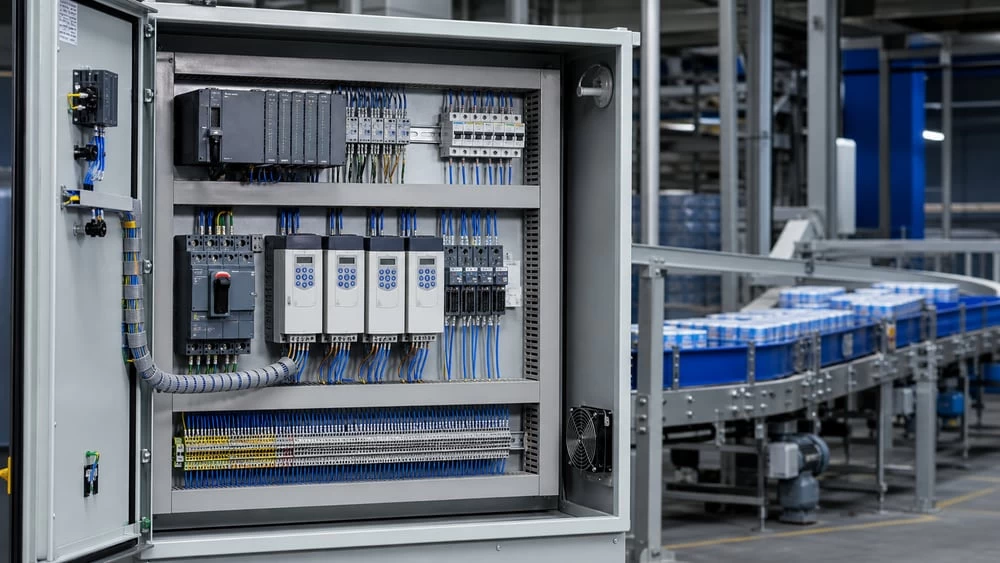
Panel cooling, filters, heat load, cable entries, door clearance, service access, and installation location should be shown on the layout. Any final type rating or certification must be supported by the complete assembly.
Electrical information to put in the RFQ
| Topic | Buyer input | Design output to review |
|---|---|---|
| Supply | Voltage, phase, frequency, grounding | One-line and load schedule |
| Fault current | Available value at installation point | Panel SCCR and protective devices |
| Environment | Dust, water, corrosion, temperature | Enclosure and thermal approach |
| Approval | Listing, field evaluation, AHJ needs | Defined certification scope |
| Documentation | Language, format, standards, copies | Schematics, BOM, I/O, manuals |
Recommended Project Workflow
Issue an electrical specification
State supply, environment, approval scope, component rules, and documentation.
Confirm fault-current data
Coordinate the installation point with the facility electrical team.
Review design documents
Approve one-line, schematic, panel layout, BOM, I/O, network, and field wiring.
Plan inspection and tests
Define panel tests, machine tests, site checks, and approval responsibilities.
Frequently Asked Questions
Does a UL 508A panel mark certify the entire conveyor machine?
No. UL explains that an industrial control panel certification covers the panel, not automatically the connected loads or complete equipment.
Is a NEMA Type rating the same as an IP rating?
They are different systems with different tests and definitions. Select the required system and rating from the site environment.
Why is available fault current needed?
It is required to coordinate equipment and panel short-circuit ratings with the installation.
Can a supplier choose voltage after receiving the order?
Voltage, phase, frequency, and grounding should be confirmed before component and panel design.
Who approves the installation?
The buyer should coordinate the authority having jurisdiction, facility engineering, integrator, and required certification bodies.
Authoritative References
These references support the regulatory or standards context. Project requirements must still be confirmed for the installed application.
Planning a Conveyor Project?
Send the product, load, throughput, layout, environment, controls, and destination requirements for an engineering review.