
Buyer Brief
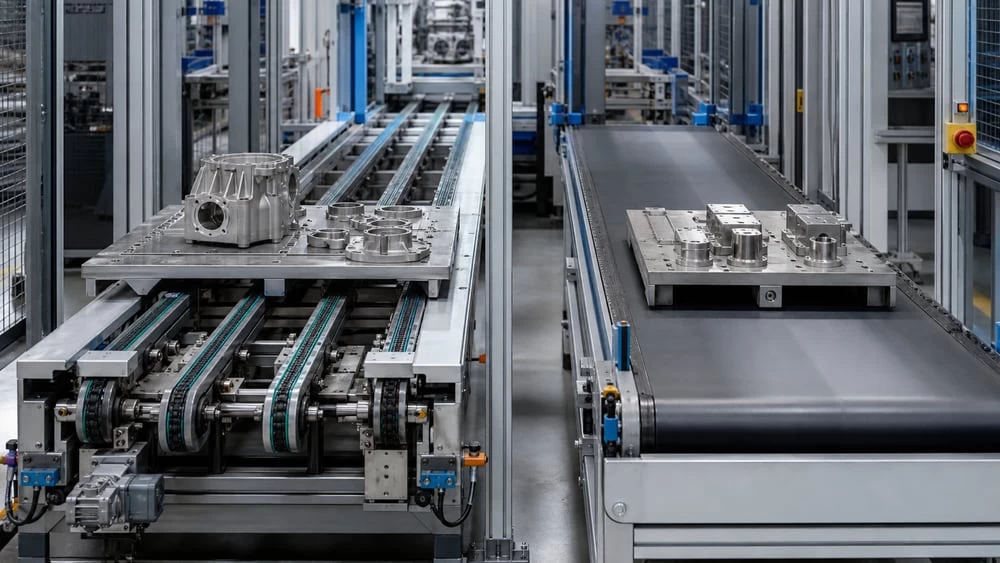
Timing-belt and flat-belt pallet conveyors can both serve automated assembly, but they solve different motion and support problems. The better choice depends on pallet contact geometry, payload, speed profile, positioning method, accumulation behavior, noise, contamination, and transfer layout.
In This Guide
Where a timing-belt conveyor can make sense
A toothed belt provides positive engagement between the belt and pulley, which can support repeatable motion and coordinated drive behavior. It is commonly considered when the application benefits from controlled acceleration, defined belt tracking, or synchronized conveyor sections.
The pallet interface still needs review. Contact width, tooth pitch, belt support, payload distribution, and transfer gaps influence the result, so the belt type alone does not guarantee workstation accuracy.
Where a flat-belt conveyor can make sense
A flat belt provides a broad, continuous contact surface and can support smooth, quiet transport. It may be useful for pallets with compatible runners, moderate loads, and layouts where simple straight conveying is the main requirement.
Check friction, belt tension, product contamination, accumulation method, and the effect of starts and stops. A flat belt can slip under some conditions, which may be acceptable or may require a different control and stopping strategy.
Positioning is a separate engineering decision
Do not use belt selection as a substitute for defining workstation location tolerance. Precision work often relies on a stopper, locating pins, lift-and-locate mechanism, or fixture rather than the conveying medium alone.
Ask how the pallet is detected, stopped, referenced, released, and recovered after a fault. Those details determine repeatability more directly than marketing terms such as “precision conveyor.”
Practical comparison
| Factor | Timing belt | Flat belt |
|---|---|---|
| Drive behavior | Positive tooth engagement | Friction-based belt contact |
| Pallet support | Defined belt contact lanes | Broad continuous surface |
| Noise | Depends on tooth, speed, and structure | Often smooth and quiet when correctly tensioned |
| Transfers | Pitch and pulley geometry require review | Pulley diameter and transfer gap require review |
| Maintenance | Inspect teeth, tension, tracking, and wear | Inspect surface, tension, tracking, and contamination |
Recommended Project Workflow
Define the pallet underside
Share drawings of runners, fixture plate, support zones, and prohibited contact areas.
Model the motion
State speed, acceleration, stop frequency, accumulation, and required cycle time.
Review transfers
Check end-drive, center-drive, curve, lift, and cross-transfer interfaces.
Test the actual load
Use representative pallets and workpieces during acceptance testing.
Frequently Asked Questions
Which belt is better for precise positioning?
Workstation positioning normally depends on the locating and stopping method. Belt type supports transport but should not be treated as the only accuracy device.
Can pallets accumulate on either belt type?
Accumulation is possible only with a suitable conveyor and control strategy. Confirm whether pallets can slip, queue, or require zero-pressure release.
Does a timing belt always run faster?
No. Permissible speed depends on load, pitch, drive sizing, transfer geometry, control profile, and the complete system.
Which option is easier to clean?
That depends on the belt material, frame access, contamination, and cleaning method. Provide the actual environmental requirement.
What information should a supplier compare?
Provide payload, pallet underside, dimensions, speed profile, stop frequency, positioning tolerance, environment, and maintenance expectations.
Planning a Conveyor Project?
Send the product, load, throughput, layout, environment, controls, and destination requirements for an engineering review.